

360° ventilation expertise
in the KONZMANN companies
in the KONZMANN companies
The subsidiaries of the KONZMANN Group cover all areas of industrial ventilation technology and implement them professionally. Individual and economically viable solutions for commercial, industrial and public-sector applications are developed, planned and implemented – from the initial concept through to turnkey installation and system integration.
The focus is on people’s well-being and clean, healthy indoor air quality. The companies of the KONZMANN Group have particular expertise in ventilation technology for hotels and hospitality businesses. Tailored and professional solutions are designed to meet the specific requirements of these sectors, helping to remove moisture, odours and pollutants, support a comfortable indoor climate and protect the health of guests and employees.
Flexible systems respond to different requirements and can control energy use according to demand while taking legal and safety requirements into account. By integrating modern technologies – particularly heat pumps, intelligent controls and modern filtration technology – energy use, air quality and operating conditions can be adapted to the respective requirements. Industrial ventilation technology is therefore a key part of energy and building technology and supports a healthy, safe and functional working environment.
Ventilation and air handling systems (RLT)
Process air technology
Our subsidiaries implement systems for extracting, separating and cleaning dust, gases and vapours generated by technical or industrial processes. Innovative solutions such as oil and emulsion mist separators are used to capture pollutants directly at the source. Inline measuring systems enable continuous emissions monitoring, while automated filter cleaning systems support uninterrupted operation. This can help protect employees and machinery and support compliance with applicable environmental requirements.
Ventilation and extraction systems
The subsidiaries of the KONZMANN Group install high-performance systems for targeted air exchange and the removal of used air. These include specialist solutions such as ventilation ceilings, which support even air distribution, particularly in hospitality settings, event spaces and halls. Heat pumps can also be integrated to provide additional flexibility for both heating and cooling. Intelligent controls automatically adapt the system to changing operating conditions and can support demand-based air quality and optimised energy use.
Special air treatment systems
Air conditioning and airflow management
Compliance with legal and safety standards

Innovative advantages with the KONZMANN Group in ventilation technology
Comprehensive air technology expertise
The companies of the KONZMANN Group provide comprehensive solutions from consulting and planning through to turnkey implementation and maintenance – individually tailored to the requirements of industry, commerce and the public sector.
Technological innovation and optimised energy use
By using modern technologies such as heat recovery, intelligent controls, CO sensors and heat pumps, air technology systems can optimise energy use and be adapted to current and future requirements.
Tailored industry solutions
For demanding areas such as hotels, hospitality, clean rooms or IT centres, the subsidiaries of the KONZMANN Group develop industry-specific air technology concepts that ensure hygiene, comfort and operational reliability.
Maximum air quality and hygiene
Flexible and reliable system architecture
The air technology solutions are modular, adapt flexibly to changing operating conditions and provide maximum reliability through redundancy and intelligent monitoring.
Compliant and sustainable implementation
All air technology systems are implemented in accordance with current legal requirements and are regularly inspected and maintained – including support with funding applications for suitable technical systems.

Use the online F‑Gas Check! Clarity in 5 minutes
With the current F-gas Regulation (EU) 2024/573, the EU is tightening the requirements for the use of fluorinated refrigerants in refrigeration, air-conditioning and heat pump systems. The aim is the gradual phase-out of HFCs by 2050. Quantity restrictions and application-specific bans on refrigerants with a high GWP (Global Warming Potential) already apply. For operators and planners, this means: Early consideration of low-GWP refrigerants and natural refrigerants such as CO2 (R744), ammonia (NH3) or propane (R290) can help align systems with future regulatory requirements.
Ventilation and Exhaust Systems
Specialist ventilation concepts and systems for hotels and hospitality
Ventilation and extraction systems are essential for industrial, commercial and public-sector facilities. They provide a reliable supply of fresh air, remove used air and pollutants, and can optimise energy use through modern technologies such as heat recovery and intelligent controls. In industrial halls, workshops or logistics centres, high-performance systems allow flexible adaptation to changing operating conditions and support compliance with occupational and environmental protection requirements.
The companies of the KONZMANN Group have particular expertise in ventilation technology for hotels and hospitality businesses. Individually planned ventilation solutions support a comfortable and hygienic indoor climate in restaurants, hotels, event venues and public facilities – from kitchens with specialist grease separation systems to low-noise systems for guest areas. Central supply and extract air systems with integrated filters and heat recovery support demand-based fresh-air supply, while modern combinations of ventilation and heat pump technology provide heating and cooling functions. In this way, legal hygiene and comfort requirements can be taken into account and suitable technical conditions for reliable operation can be created.
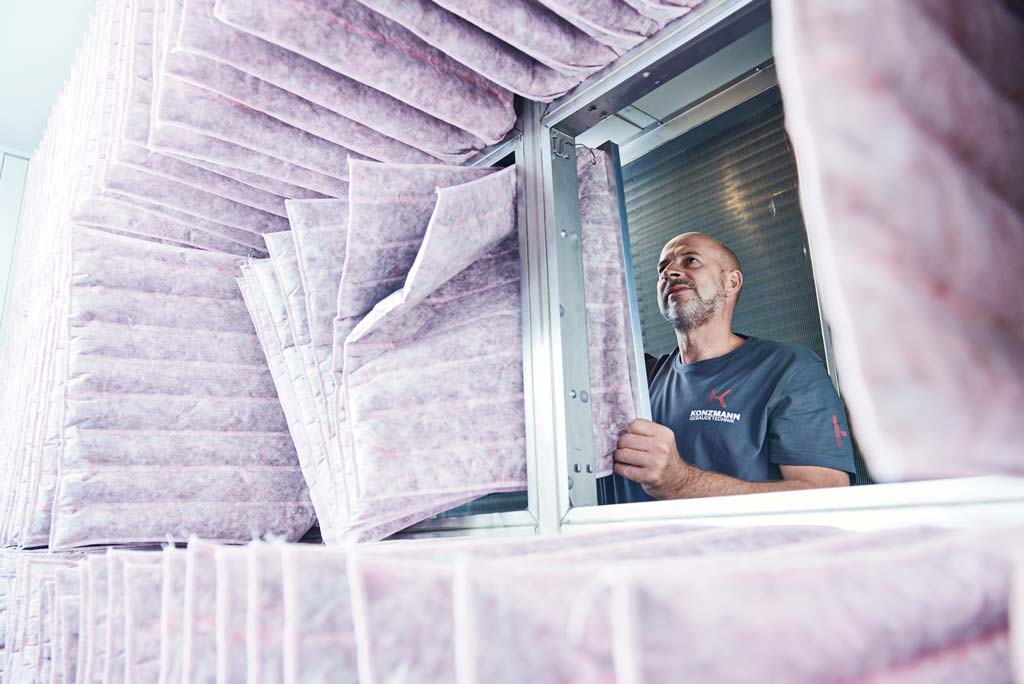
Benefits
- Hygienic, low-odour and comfortable environment for guests and staff
- Potential to reduce energy use through heat recovery and intelligent controls
- Reliable removal of grease, odours and pollutants in kitchens
- Low-noise operation for a comfortable environment
Relevance for industrial and commercial clients
- Essential for restaurants, bars, hotels, event venues and catering businesses
- Supports compliance with hygiene and workplace regulations
- Enhances attractiveness and competitiveness
Relevance for public sector clients
- Important for canteens, cafeterias, theatre catering and public event spaces
- Supports health protection and comfort in public facilities
Industrial Air Technology
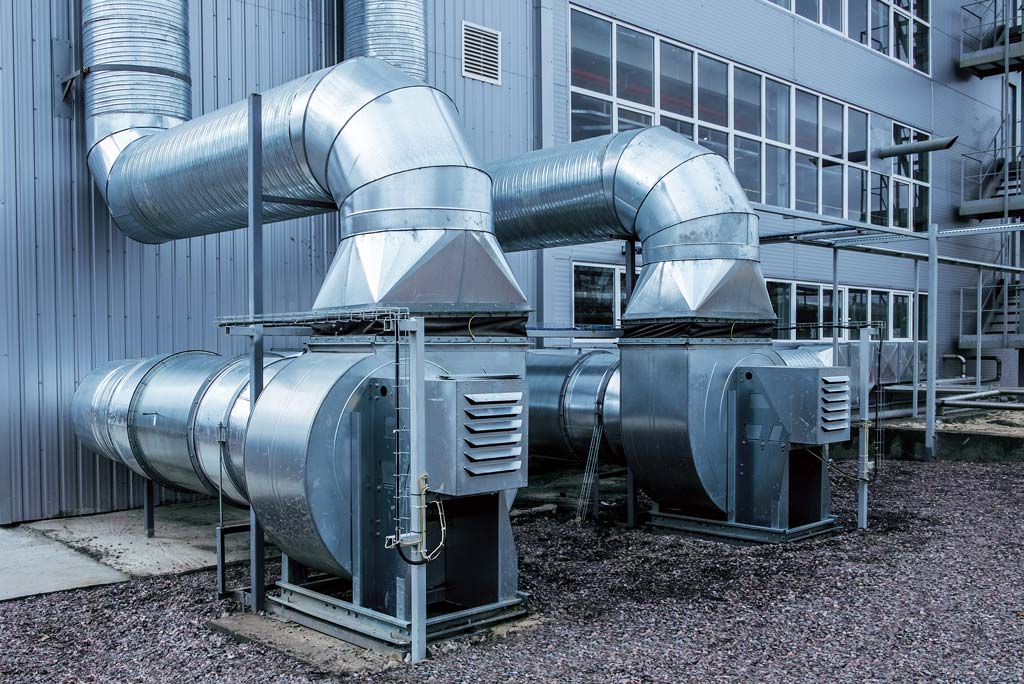
Industrial air technology covers all technical measures and systems used to capture, separate and clean pollutants, dust, gases and vapours generated by industrial and technical processes. Its purpose is to support air quality in production and storage areas while protecting employees, machinery and products. Modern systems use innovative filtration and extraction technologies, such as oil and emulsion mist separators, which capture pollutants directly at the source. These systems are complemented by inline measuring systems for continuous emissions monitoring and automated filter cleaning, enabling uninterrupted operation.
In addition, specialised solutions are used to reduce odours and CO2 and to meet specific air quality requirements. Redundant systems provide maximum operational reliability. The integration of heat pumps and the use of renewable energy can help reduce the use of fossil energy sources for heating and air conditioning in halls. Heat recovery and intelligent control systems can also optimise energy use and support flexible adaptation to changing production conditions.
Industrial air technology is therefore a key element in meeting environmental and occupational safety requirements, safeguarding product quality and supporting technically coordinated industrial processes – in both the private and public sectors.
Benefits
- Protection against pollutants and improved air quality
- Maintaining production-specific air quality requirements
- Potential to reduce emissions and energy consumption
- Compliance with environmental, occupational and safety requirements
- Flexible adaptation to different production conditions
- Support in reducing the use of fossil energy sources and potential to reduce operating costs
- Protection of sensitive processes and products
Relevance for industrial and commercial clients
- Essential in industries with emission-intensive or sensitive processes (e.g. metalworking, chemicals, pharmaceuticals, food and plastics production, laboratories)
- Meets legal requirements and ensures production safety
- Secures product quality and operational reliability
- Supports sustainable and efficient operations
Relevance for public sector clients
- Protection of employees in municipal workshops, depots, laboratories and educational facilities
- May be a requirement for funding or certification, depending on the programme
- Support in meeting environmental and occupational safety requirements
- Support for safe and resource-conscious operations in public-sector facilities
Cleanroom Air Technology
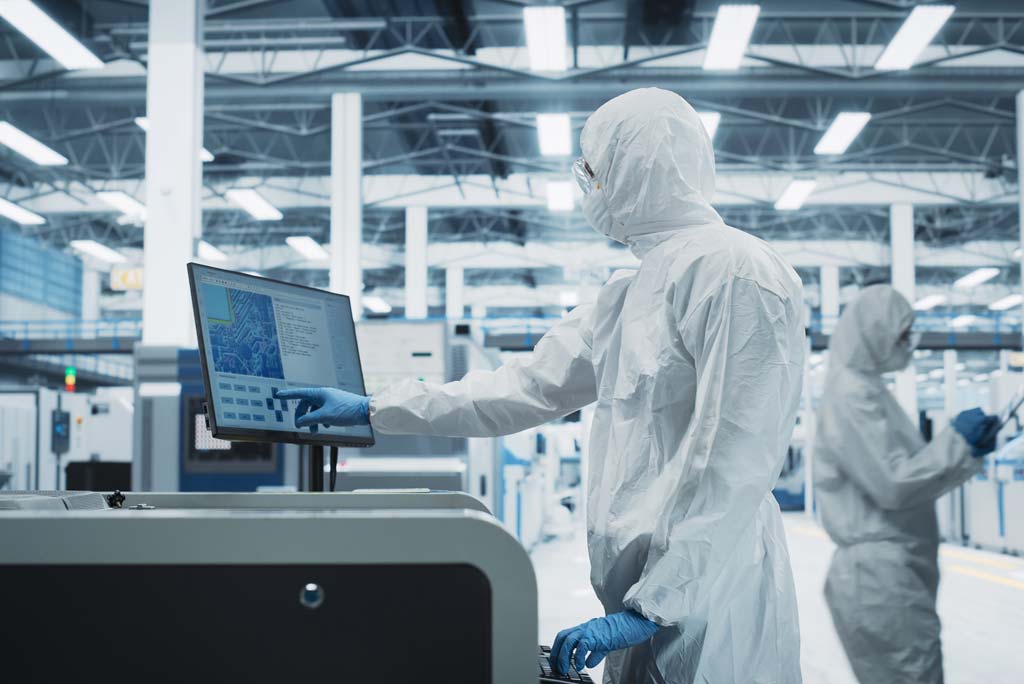
In clean rooms, operating theatres and healthcare laboratories, the highest requirements apply to air purity as well as to the precise control of temperature and humidity. The ventilation and air-conditioning system is a key element in maintaining hygiene and infection control. Its design is based on clearly defined standards such as DIN 1946-4 or ISO 14644-1, which set requirements for air purity, air change rates and filtration technology, among other factors.
High-performance filters such as HEPA or ULPA filters reliably remove even very fine particles from the air. Targeted pressure management – positive pressure in operating theatres and negative pressure in laboratories – provides effective protection against contamination. Redundant systems ensure maximum operational reliability, while modern heat pumps support climate control and can help optimise energy use.
Clean-room air technology in operating theatres and laboratories is therefore a complex interaction of filtration technology, airflow, pressure control and climate control. A high level of hygiene, safety and comfort can only be achieved through consistent implementation of technical requirements, regular monitoring and the use of modern technology.
Airflow & air exchange
Specialized airflow systems and high air exchange rates ensure effective dilution and removal of germs and particles.
Filtration technology
Multi-stage filters (pre-, fine-, and HEPA filters) ensure maximum air purity.
Pressure management
Positive pressure protects operating rooms, negative pressure protects laboratories – preventing contamination.
Indoor climate
Precise control of temperature and humidity ensures stable, safe conditions.
Operational reliability
Redundant systems and regular maintenance ensure reliable performance.
Energy efficiency
Benefits
- Maximum air purity and protection against contamination
- Reliable compliance with hygiene and safety standards
- Precise climate control for sensitive areas
- Maximum reliability through redundant systems
Relevance for industrial and commercial clients
- Indispensable for laboratories, pharmaceutical industry, medical technology, and research
- Ensures product quality and process reliability
- Meets strict standards and certifications
Relevance for public sector clients
- Essential for hospitals, university clinics, and public research institutions
- Contributes to health protection and compliance with legal regulations
Ventilation and climate concepts
for IT data centers
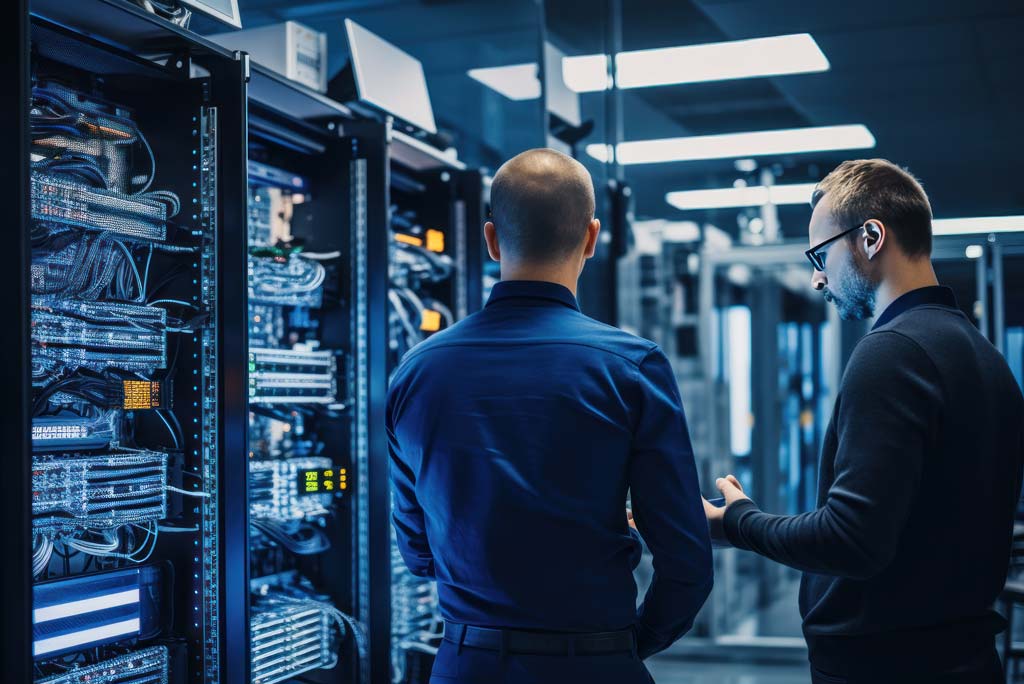
IT centres and server rooms require precise and fail-safe climate control to protect sensitive IT equipment from overheating, moisture and dust. Precision air-conditioning units with a high level of control accuracy maintain stable temperature and humidity levels. Redundant ventilation systems ensure uninterrupted operation, even if individual components fail. The integration of heat pumps enables cooling and, where required, heating and can help optimise energy use. Air filters and continuous monitoring systems maintain the required air quality over the long term.
Benefits
- Reliable protection of IT infrastructure against overheating and moisture
- Maximum operational reliability through redundancy
- Cooling with modern heat pump technology to optimise energy use
- Compliance with air quality standards through filtration and monitoring systems
Relevance for industrial and commercial clients
- Indispensable for data centers, server rooms, and IT infrastructures across all industries
- Ensures uninterrupted operation and protects against data loss
Relevance for public sector clients
- Important for municipal IT centers, schools, universities, and public authorities
- Contributes to ensuring digital infrastructure and data protection
Rethinking energy: heating and cooling with large-scale heat pumps for commercial and industrial applications
Use modern technology to reduce energy use and CO2 emissions – and develop your company’s heat supply further.
Large-scale heat pumps offer a wide range of options for providing heating and cooling in industrial and commercial applications. They can make use of previously unused waste heat from production processes or building technology as an energy source and help reduce the use of fossil fuels. Modern large-scale heat pumps cover high output ranges and can also be used for industrial processes with elevated temperature requirements – for example for heating, air conditioning or hot water generation in large buildings and production facilities.
Integrating large-scale heat pumps into existing systems, often in combination with heat recovery and intelligent controls, can offer potential to reduce operating costs and CO2 emissions. Using electricity from renewable energy sources or on-site photovoltaic systems can further support this effect. Cascade configurations involving several heat pumps allow heating and cooling demand to be adapted flexibly to varying loads.
Large-scale heat pumps are used in applications including the textile and food industries, paint shops, data centres and the heating and cooling of office and commercial buildings. Depending on the application, they can help reduce the use of fossil fuels and energy-related CO2 emissions.
The companies of the KONZMANN Group handle the planning, design and implementation of large-scale heat pump solutions for their customers – tailored to the individual requirements of each industrial or commercial operation. By analysing existing processes and energy sources and integrating modern control and heat recovery systems, the systems are adapted to the relevant technical and economic conditions. In this way, the companies of the KONZMANN Group support their customers in optimising energy use and reducing CO2 emissions.
We’re always by your side!
24/7 service and
comprehensive monitoring!
We’re always here for you: You can reach us via our service hotline 24 hours a day, 365 days a year. Optional remote monitoring or building management systems keep a watchful eye on your property.
- Round-the-clock service for fast support
- Maintenance and servicing for long-term operational reliability
- Remote monitoring or building management systems